HVAC SEO Services
HVAC SEO needs local visibility, technically sound service pages, useful equipment and financing content, and planning that reflects seasonal demand. We build those pieces around how emergency and planned-replacement buyers actually search.
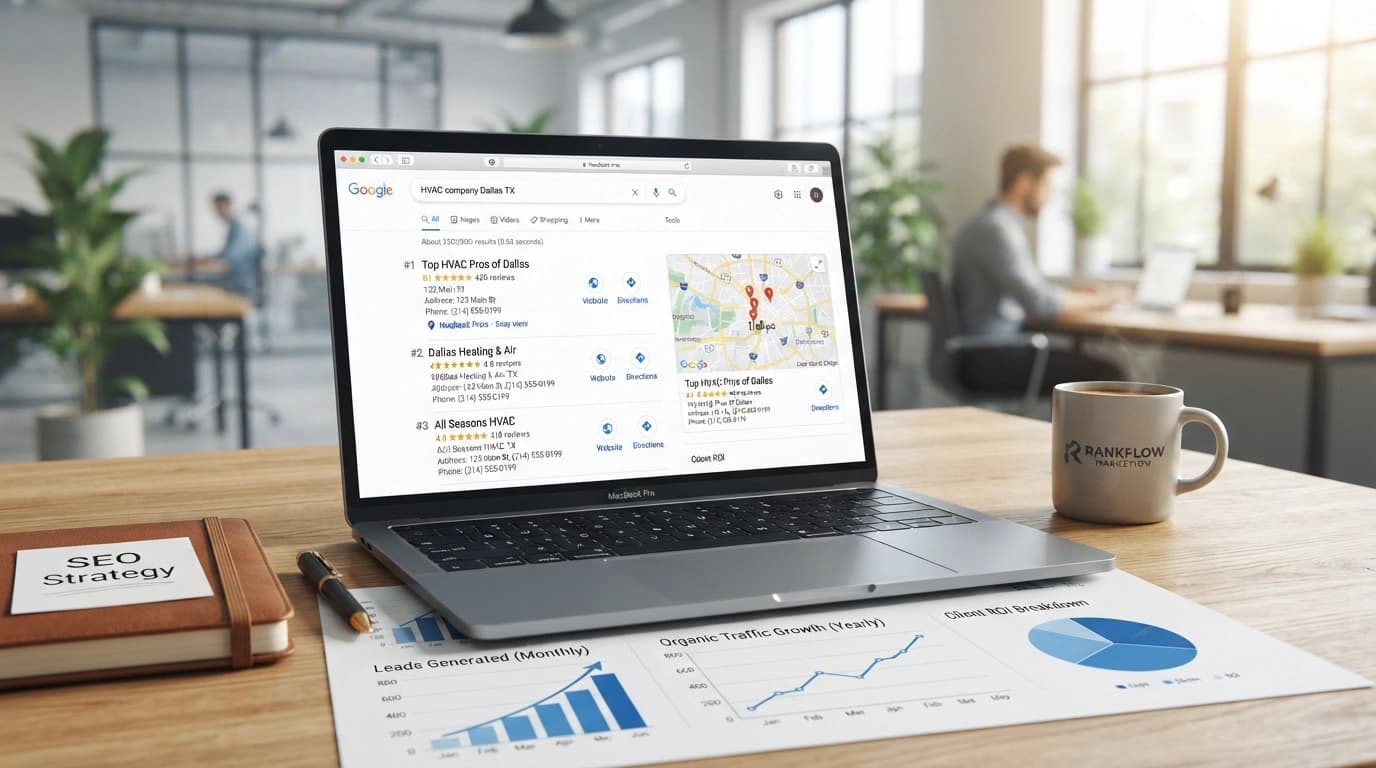
HVAC SEO is mostly a Map Pack, seasonality, and dual-buyer-mode problem
Most HVAC companies looking at SEO have been pitched a generic local-SEO playbook: keyword research, blog posts, technical fixes, monthly reports. The work might get done. The rankings sometimes move. But the leads don't — because the playbook isn't built around how HVAC buyers actually search.
HVAC SEO has several distinct workstreams. The first is local visibility, including the Map Pack that can appear for searches like "AC repair near me" or "HVAC company [city]." Google evaluates local results using relevance, distance, and prominence, so we work on business information, reviews, citations, service-area content, and the broader site together.
The second is the dual buyer modes. Emergency-repair buyers need immediate service information and a low-friction call path, while planned-replacement buyers may want financing, equipment details, credentials, warranties, and consultation options. Those intents deserve different pages and conversion paths.
The third is seasonality. Heating and cooling demand can change quickly with weather and time of year. We use market-specific search and booking data to plan content before likely demand windows instead of publishing reactively after demand has already shifted.
Get all three right and the channel mix becomes easier to evaluate: local visibility can support emergency-intent discovery, equipment-specific pages can support planned research, and seasonal content can be published ahead of expected demand. SEO is a longer-term channel, so we judge it against measured progress and qualified opportunities rather than a fixed payback year.
"Local HVAC visibility is not won by one tactic. Useful service pages, accurate business information, reviews, technical health, and local relevance all have to support the same buyer journey."
Why most HVAC SEO programs underperform
Treating HVAC SEO like generic local SEO
Most agencies running HVAC SEO are using the same playbook they use for plumbers, electricians, and roofers — generic local citations, basic GBP setup, a few service pages. The HVAC-specific layers — equipment-specific landing pages, brand-specific install pages (Carrier, Trane, Lennox), seasonal content cycles, financing-eligible content — get skipped entirely.
Ignoring the dual buyer modes
HVAC has distinct buyer modes. Emergency-repair searches often need immediate service information and a clear call path, while planned-replacement searches benefit from financing context, equipment information, proof, and consultation options. We build separate content and conversion paths around those intents.
Missing the seasonal demand curve
Heating and cooling demand changes with season and weather, so a flat publishing calendar can miss important windows. We plan service and educational content around the markets you serve and the seasonal patterns visible in your own search and booking data.
Backlinks that don't move the needle
Low-quality link packages, irrelevant guest posts, and manipulative link networks can create unnecessary search risk. We focus on legitimate mentions and links from relevant local publications, industry associations, manufacturer or dealer resources where appropriate, partners, and earned media.
What HVAC SEO actually looks like in execution
Five workstreams can run in parallel. We prioritize them from the audit based on the gaps most likely to limit crawlability, local relevance, trust, and qualified organic demand.
Map Pack + emergency-intent rankings
Google Business Profile optimization, local citations, service-area pages, and compliant review acquisition. For local-intent HVAC searches, Map Pack visibility can be an important discovery surface, so we manage the profile, reviews, local relevance, and on-site signals as an ongoing workstream.
Service-page content (repair + install)
Separate pages for AC repair, AC installation, furnace repair, furnace installation, heat pump install, ductwork, indoor air quality, and maintenance plans. Generic "Services" pages lump everything together and rank for nothing. Dedicated service pages with real local content rank for high-intent commercial queries.
Seasonality-aware content calendar
HVAC demand is seasonal, and search interest can change materially with weather and time of year. We plan content ahead of expected demand windows so useful pages have time to be crawled, indexed, and evaluated before peak interest arrives.
Review acceleration program
Reviews can support local prominence and buyer trust, but local rankings are not controlled by one factor. We build a compliant review-request process while also improving Google Business Profile completeness, local relevance, citation consistency, and on-site service-area signals.
Technical SEO + schema
Page speed, Core Web Vitals, schema markup (LocalBusiness, Service, FAQPage), service-area schema, mobile usability. Most HVAC sites have technical issues capping rankings before content even gets a chance — and HVAC is more mobile-dominant than almost any other category, so mobile speed isn't a nice-to-have.
The four keyword categories HVAC SEO has to cover
An HVAC SEO program that only targets one of these gets disproportionate competition for shrinking returns. Covering all four — and timing each to its seasonal demand curve — is what builds an engine that holds up across years.
Emergency commercial
"AC repair [city]", "emergency HVAC [city]", "furnace not working [city]", "AC won't turn on"
Urgent local intent. Strong local visibility, trust signals, and a clear phone path matter for this query group.
Planned commercial
"new AC installation [city]", "HVAC replacement cost", "heat pump install quote", "[brand] dealer [city]"
Planned-replacement research can involve financing, equipment choices, efficiency, warranties, and contractor comparison. Useful pages should support those questions and provide a clear consultation path.
Maintenance + tune-up
"AC tune-up [city]", "HVAC maintenance plan", "furnace inspection cost"
Seasonal — pre-summer and pre-winter spikes. Steady margin and a pipeline into replacement work later.
Research + decision
"how long do AC units last", "heat pump vs furnace", "[brand A] vs [brand B] AC", "is HVAC financing worth it"
Lower commercial intent, but where buyers form opinions before they call. The site that ranks here gets into the consideration set.
Why HVAC SEO timing matters more than HVAC SEO volume
Seasonal planning matters because search engines need time to discover, crawl, index, and evaluate new or substantially changed pages. We use historical search demand, weather-sensitive service patterns, and business priorities to publish important content before expected demand where possible.
How we work on HVAC SEO engagements
Audit + competitive baseline
We pull your current Map Pack rankings, GBP completeness, review velocity vs. competitors, technical foundation, service-page structure, and backlink profile — and benchmark against the two or three HVAC competitors winning your service area. Delivered week one. This is also where we tell you honestly if SEO isn't the right wedge for your specific market.
Map Pack + review acceleration first
We optimize the Google Business Profile, build a compliant review-request process tied to completed jobs, fix citation inconsistencies, and improve service-area coverage. Priority depends on the baseline audit and the competitiveness of the market.
Equipment-specific service pages
Dedicated pages for AC repair, AC installation, furnace repair, furnace install, heat pump install, mini-split install, ductwork, indoor air quality, and maintenance plans — plus brand-authorized-dealer pages if applicable (Carrier, Trane, Lennox, Bryant). Generic "Services" pages get replaced with structured, intent-specific content that ranks.
Seasonality-led content production
Content calendar mapped to the seasonal demand curve: pre-summer AC content live by March, pre-winter heating content live by September, year-round IAQ and maintenance content filling shoulder seasons. We lead the curve, not chase it. This timing alone is the difference between a program that compounds and one that always shows up late.
Earned-link outreach + reporting
Local news features, regional home-improvement publications, contractor association memberships, manufacturer dealer listings. Slow, manual, the only kind of link building that compounds. Plus monthly reporting tied to qualified leads — not rankings, not traffic. If a workstream isn't producing inquiries, we kill it instead of padding the slide deck.
HVAC SEO FAQs
How long does HVAC SEO take to show results?
How much does HVAC SEO cost?
Do you guarantee specific rankings?
What's different about HVAC SEO vs. generic local SEO?
Should I do HVAC SEO or HVAC PPC first?
Should we have separate pages for AC, furnace, heat pump, and other equipment?
We've been burned by an SEO agency before. Why should we trust this one?
SEO is one channel. Here's the rest of the HVAC program.
Want to see where your
HVAC SEO is leaking?
Get a free HVAC SEO audit. We'll review your Map Pack rankings, review velocity, service-page structure, seasonality timing, and competitor profile — and tell you what's working, what's broken, and what to fix first. No pitch.