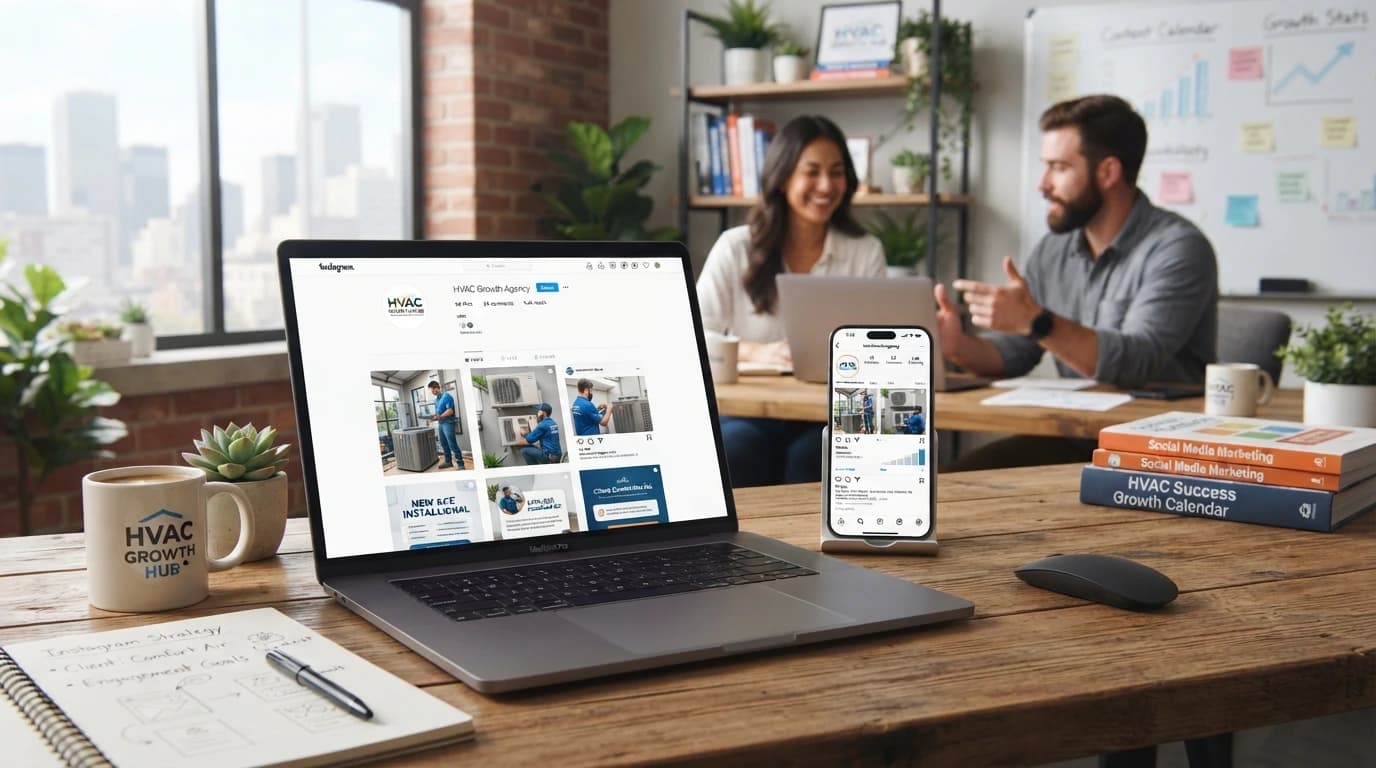
Organic content + Meta retargeting for HVAC contractors

HVAC Social Media

HVAC social is mostly run wrong because agencies treat it like consumer brand social. It's actually local contractor marketing — and the highest-ROI content isn't branded graphics about clean air. It's the technician on the truck explaining what they just fixed.

45+
primary HVAC buyer age — Facebook still lead platform
90%+
of HVAC site visitors don't convert on first visit — retargeting catches them
2 modes
organic trust-building + paid retargeting — separate jobs
0
cold-Meta HVAC campaigns we'd call a primary lead source
Overview

HVAC social media is local contractor marketing, not consumer brand marketing

Most HVAC contractors asking about social media want one thing: more leads. The instinct is to run Facebook or Instagram ads targeting homeowners in their service area, watch the impressions roll in, and wait for the inquiries. They wait a long time. The leads that do come in are usually low-quality — renters, people curious about replacement cost, tire-kickers who clicked because the creative looked good but have no real intent to call a contractor.

The reason is structural. HVAC isn't a category where buyers scroll Instagram, see a cold ad, and book a service call in three minutes. Emergency-mode buyers Google "AC repair near me" from their broken-AC living room — they're not on social. Planned-mode buyers research for weeks across Google, YouTube, and review sites — also not converting from a cold social ad. The buyers who eventually do convert from social are the ones who saw your content for months before they needed a contractor, and remembered you when the moment came.

That's why HVAC social media is actually two jobs that most agencies run as one. The first is organic content — Facebook posts in local homeowner groups, Instagram Reels of real installs, technician-led explainer videos, customer interviews about real bill changes, pre-season maintenance reminders. None of this produces leads in the next 30 days. All of it builds the familiarity and trust that buyers need across the months between when they first hear your name and when they actually need you. They follow you, see your technicians on their feed, watch you handle real customer situations, and call when their AC dies.

The second job is Meta retargeting — paid ads served exclusively to people who've already interacted with you. Site visitors who hit the install quote page but didn't book. Blog readers who consumed troubleshooting content. Video viewers who watched 50%+ of an install reel. Existing customers retargeted with maintenance plan offers. This is where paid social actually earns its budget in HVAC, because you're paying to re-engage warm intent — not buy cold attention.

And underneath both: the format that actually works. HVAC social isn't about the company; it's about the technician. The buyer wants to feel comfortable letting someone into their house. Crew-led content — actual technicians on the trucks, explaining what they just fixed, walking through equipment they just installed, talking through what to expect — outperforms branded content by a wide margin. The face that knocks on the door is the trust signal. Most HVAC social content gets this exactly backwards and features the company owner instead.

"Cold Meta prospecting for HVAC is mostly a myth that agencies keep alive because the spend is easy to bill against. The real HVAC social engine is technician-led organic content plus retargeting — nothing else."

What's broken

Why most HVAC social media programs underperform

Posting like a consumer brand instead of a contractor

Most HVAC social feeds look like they were built by someone who's never been on a service call — branded quote graphics, "happy Friday" posts, generic stock imagery, motivational content about clean air and energy efficiency. HVAC buyers don't engage with any of it. They engage with real installs, real technicians, real fixes, and real customer interactions. Stop posting brand content. Start posting evidence.

Trying cold Meta prospecting at scale

Cold Meta ads for HVAC consistently produce high-volume, low-quality leads — renters, people just curious about what AC replacement costs, tire-kickers who clicked because the creative looked good. The buyers who convert from HVAC social came in cold but were warmed up by retargeting, organic content, or a search-driven first visit. Cold prospecting at scale is one of the most common HVAC social budget drains.

Featuring executives instead of technicians

Most HVAC social content features the company owner or marketing manager. The buyer doesn't care about either of them. The buyer cares about the technician who's about to walk through their door. Crew-led content — the actual technicians on the trucks, doing the actual work, explaining what they just fixed — outperforms executive content by a wide margin in HVAC specifically. The face that knocks on the door is the trust signal.

Ignoring the maintenance plan content opportunity

Maintenance plans are the highest-margin recurring revenue HVAC has, and the single most under-marketed content category in HVAC social. Most contractors post about emergency repair and installation — and skip the steady drumbeat of pre-season maintenance reminders, "what's included in your tune-up" explainers, customer testimonials about avoided breakdowns, and seasonal preparation checklists. A consistent maintenance content track quietly compounds into a stable book of recurring revenue.

Platforms

The five platforms HVAC social actually runs on

Most HVAC contractors should commit to two or three of these — not all five. Spreading thin across every platform produces inconsistent presence and worse results than focused depth on the platforms that match your buyer demographic.

Facebook (still the lead platform for HVAC)

Lower organic reach than it once was, but still where the majority of HVAC buyers (homeowners 45+) actually spend time. Local homeowner groups and neighborhood-specific Facebook communities are where word-of-mouth recommendations happen — and where you want to be visible. Treat Facebook as a credibility layer, a community engagement channel, and a Meta retargeting platform. Not where viral organic happens, but where most of your buyers live.

Instagram + Reels

Lower share of HVAC buyer demographics than Facebook, but the engagement quality is high — younger first-time homeowners, people doing their first AC replacement, planned-mode buyers researching brands. Reels of installs, technician explainer videos, before/after equipment swaps, and ductwork drone footage routinely outperform polished branded content. Cadence over polish.

TikTok (educational capture)

Underused in HVAC and rising. The opportunity isn't brand awareness — it's educational capture. Younger first-time homeowners search TikTok for "what's wrong with my AC," "why is my furnace making this noise," "is this normal." Short-form explainer content from a real technician earns reach because the niche is undersaturated, and the audience converts later when they need a contractor in your service area.

YouTube (organic + Shorts)

Long-tail compounding asset. A library of 30–60 evergreen videos — equipment troubleshooting, "should I repair or replace," brand comparisons, maintenance walk-throughs, post-install monitoring — earns search traffic for years. YouTube Shorts give you a second distribution layer. Lower cadence than the daily platforms, much higher half-life. Most local HVAC contractors ignore YouTube; the ones who don't build a moat.

Meta retargeting (paid)

Where paid social earns its budget in HVAC. Site visitors who hit the install quote page but didn't book, blog readers who consumed troubleshooting content, video viewers who watched 50%+ of an install reel — all retargeted with offer-specific creative. Different audiences, different creative, different objectives than cold prospecting. For HVAC specifically, retargeting works hardest during shoulder season when emergency-mode buyers aren't searching but planned buyers are.

Content

Content types that actually move the needle

Six formats that consistently outperform branded graphics, motivational quotes, and stock imagery. The unifying thread: real technicians, real work, real customers, real seasonal context.

Technician-led "what we just fixed" videos
A 30-60 second clip of the tech on the truck explaining the call they just finished. Highest organic engagement format in HVAC by a wide margin.
Pre-season tune-up reminders
Pre-summer (April-May) AC tune-up content, pre-winter (September-October) furnace tune-up content. Drives maintenance plan signups and seasonal jobs.
Equipment install timelapses + drone footage
Rooftop unit swaps, ductwork installs, mini-split installations. High share rates and useful for both organic and paid creative.
Customer interviews + testimonial reels
Authentic over polished. Homeowner explaining a comfort or bill change in their own words outperforms scripted testimonials by a wide margin.
"Should you repair or replace?" educational content
High consumer interest, ranks well across platforms, drives install-quote inquiries from buyers in research mode.
Behind-the-scenes crew + truck content
Morning truck loadouts, crew prep, tool overviews. Humanizes the company and pre-builds the trust that makes the eventual service call easier.

The biggest unforced error in HVAC social

HVAC contractors run hundreds or thousands of service calls a year and capture footage from almost none of them. Every call is a content asset — the diagnosis explanation, the install timelapse, the equipment swap, the customer reaction when the house is finally cool again. A simple capture protocol on every truck (a checklist, a designated technician with a phone, a release form for customer permission) generates more usable content in a quarter than most agencies produce in a year. We help build the protocol; your team executes it on the routes they're already running.

Our approach

How we work on HVAC social engagements

01

Audit + content gap analysis

We pull your current social presence across all platforms, audit content quality and cadence, review what's actually performing, and benchmark against the two or three HVAC competitors winning in your service area. Most clients are surprised which posts are actually driving site traffic and maintenance plan signups — usually not the ones the agency was optimizing for.

02

Technician-led capture protocol

Before content production, we build the capture system: per-truck checklist, designated technician for filming, customer release process, equipment install workflow, monthly bill comparison protocol. Most HVAC contractors have hundreds of service calls a year of usable footage they're not capturing. Fixing this is the highest-leverage first step.

03

Organic content production

Facebook posts, Instagram Reels, TikToks, YouTube uploads — produced from the source footage your team captures. We focus on real technicians, real work, and real customer interactions. Cadence over polish: 3–4 Facebook posts/week, 3–4 Instagram posts/week, 1–2 YouTube uploads/month, plus seasonal maintenance content timed to lead the demand curve.

04

Meta retargeting setup + management

Audience structure: site visitors, install quote page visitors, blog readers, video viewers (segmented by view depth), existing maintenance plan customers. Different creative for each segment. Different offers for different stages of the buyer cycle. Tied back via offline conversion imports so we report on cost per booked job, not cost per click.

05

Reporting tied to pipeline

Organic: branded search lift, direct/referral traffic, video view duration, maintenance plan signups attributed to social, assisted conversions. Paid retargeting: cost per booked job, ROAS. We don't pad reports with follower counts and impressions. If a workstream isn't producing pipeline, we tell you instead of dressing it up.

Common questions

HVAC social media FAQs

Almost never as a primary lead source. Cold Meta prospecting for HVAC consistently produces high-volume, low-quality leads at cost-per-acquisition that rarely justifies the spend. The buyers who convert from HVAC social came in cold but were warmed up by retargeting, organic content, or a search-driven first visit. We use Meta primarily as a retargeting and warming layer — not a cold prospecting engine. If a cold campaign produces results in your specific market, we scale it. Most don't. The exception: maintenance plan promotion to existing customers and lookalike audiences sometimes works at lower budget tiers.
Other HVAC marketing services

Social is the trust layer. Here's the rest of the HVAC program.

Want to know if your
social budget is working?

Get a free HVAC social media audit. We'll review your content quality, technician-led gap, posting cadence, retargeting setup, and pipeline attribution — and tell you what's actually building trust, what's wasted spend, and what to fix first. No pitch.