Roofing Social Media
Roofing social media can support local proof, buyer education, community visibility, and paid audience testing. We build the program around real project evidence and qualified business outcomes rather than a generic posting calendar.
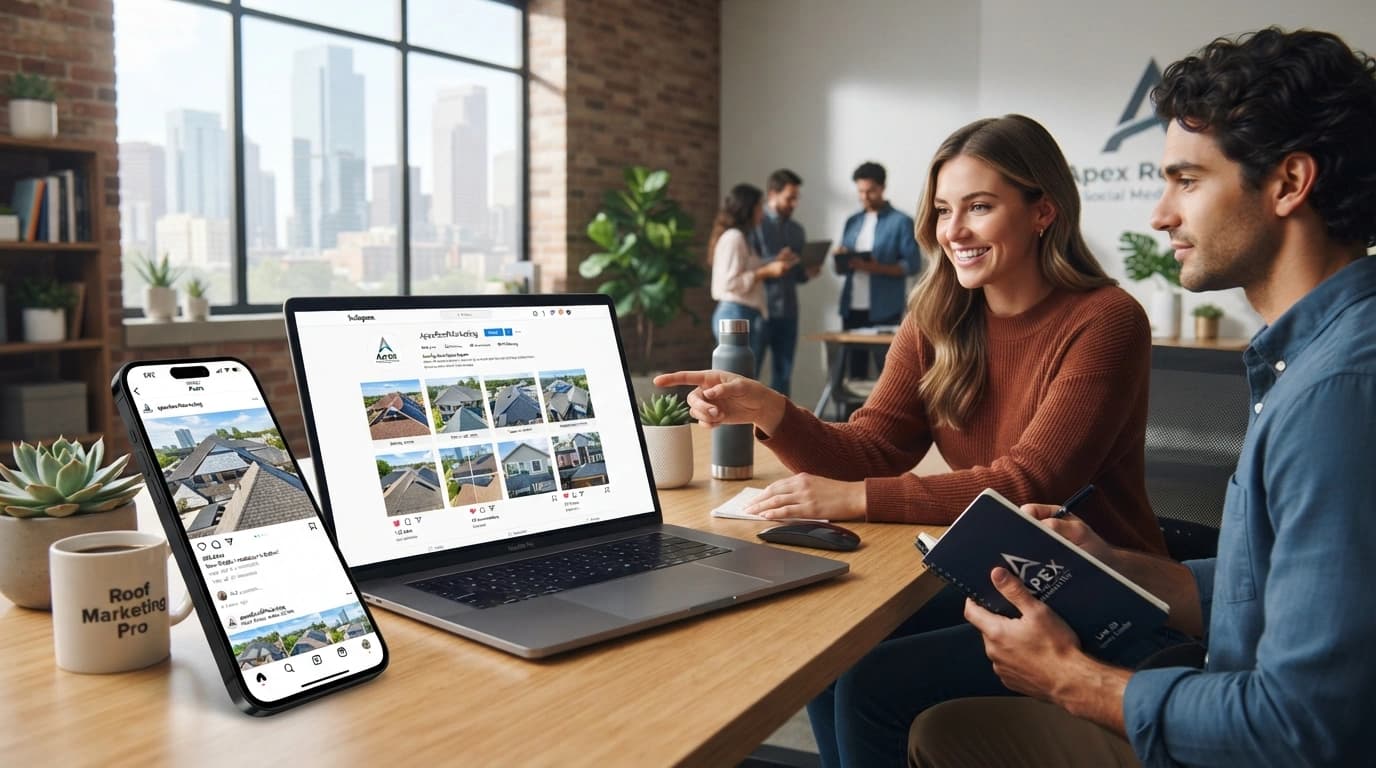
Roofing social media is a legitimacy channel disguised as a content channel
A roofing social program should do more than fill a posting calendar. Real project evidence, local service-area proof, customer stories, useful education, and responsive community participation can make the company easier to evaluate than a feed dominated by generic graphics.
Job-site content is a useful organic format because it shows real work, crews, materials, and neighborhoods. Drone footage where appropriate, before-and-after images, installation progress, and crew explanations can all become source material. We build a capture workflow that fits normal operations rather than forcing a production quota on every job.
The second dimension is community engagement. Neighborhood groups and local social channels can contain real homeowner questions, recommendations, and storm-related discussions. Participation has to respect group rules and work as genuine local engagement rather than automated promotion.
The third dimension is paid social. Instant forms can create low-friction inquiries, while click-through campaigns give the landing page more room to qualify and educate. We compare formats on booked inspections, close rate, and revenue instead of assuming the cheapest lead is the best lead.
The fourth dimension is platform mix. Facebook, Instagram, YouTube, TikTok, Nextdoor, and LinkedIn can play different roles depending on the audience, market, source material, and objective. We allocate effort according to actual reach, traffic quality, engagement, and qualified opportunities rather than platform trends.
The program combines project proof, community participation, paid audience testing, and a platform mix matched to the actual buyer. Reporting connects social activity to qualified opportunities and revenue where attribution supports it, while impressions and follower count remain supporting metrics rather than the final outcome.
"Follower count does not tell you whether a roofing social program is working. Local proof, useful content, qualified engagement, and downstream business outcomes are more meaningful signals."
Why most roofing social media programs underperform
Treating social media as a content calendar exercise
A generic calendar of branded graphics and stock imagery can miss the evidence roofing buyers may actually want to see: real projects, crews, local service areas, customer proof, and useful explanations. We prioritize content that makes the company and its work easier to evaluate.
Running Facebook lead-form ads as the primary paid channel
Instant forms can make it easy to generate inquiries, but low friction can also make raw lead count a weak measure of business value. We compare form leads with click-through campaigns using qualification, booked inspections, close rate, and revenue so cheap leads do not get mistaken for profitable acquisition.
Ignoring local community Facebook groups entirely
Local neighborhood groups can contain real homeowner questions, recommendations, and storm-related discussions. Contractors can participate where group rules allow, but the value depends on genuine local relevance and useful responses rather than promotional posting.
Posting on Instagram and TikTok while ignoring Facebook
Platform mix should follow the audience and the content you can produce well. Facebook, Instagram, YouTube, TikTok, Nextdoor, and LinkedIn can all play different roles depending on the market, buyer, and campaign objective; we do not assume one platform should dominate every roofing program.
Lead-form ads are roofing's version of cheap shared broker leads
Cheap lead volume can look strong in a report while producing weak downstream economics. We compare each format on qualification, booked inspections, close rate, and revenue so a low form cost does not get mistaken for a profitable campaign.
The five workstreams of an actual roofing social media program
Each workstream has its own discipline and measurement needs. We prioritize the areas the audit shows are limiting local proof, audience quality, community visibility, creative supply, or downstream conversion.
Job-site organic content (the engine)
Job-site content can provide credible local proof: drone footage where appropriate, before-and-after roof shots, installation progress, crews at work, and finished-project reveals. We build a capture workflow that fits normal operations instead of prescribing a fixed amount of content from every job.
Neighborhood-specific posting
Neighborhood-specific project content can make local proof more concrete. With appropriate homeowner permission, posts can reference the city or neighborhood, show recognizable project details, and help buyers understand where the company actually works.
Community group engagement
Local community groups can be useful places to answer homeowner questions and participate in neighborhood discussions, especially after weather events. The work requires genuine human participation and should be handled as community engagement rather than automated promotion.
Storm-response social activation
When a major weather event hits, homeowners may use social channels to look for local proof, project updates, and contractor information. We prepare a response playbook for real project footage, storm-related education, community questions, and appropriate claim guidance so the team is not improvising during a demand spike.
Paid social engineered for roofing buyers
Instant lead forms can produce inexpensive inquiries, but that does not automatically make them profitable. We compare lead forms, click-through campaigns, retargeting, and other formats using qualification, booked inspections, close rate, and revenue rather than raw lead cost.
Storm-response social is where local-vs-storm-chaser trust gets decided publicly
After major weather events, buyers may use social channels to check local project evidence, business history, community participation, and storm-related guidance. Having credible content and response processes in place before an event makes it easier to communicate accurately when demand and questions change quickly.
Where roofing social budget actually belongs
Platform allocation should follow your audience, available source material, campaign objective, and measured outcomes. The roles below are starting points to evaluate, not a universal budget formula.
How we work on roofing social media engagements
Audit + buyer-mix review
We review your current social presence, engagement, paid campaigns, community activity, content workflow, and buyer mix across planned replacement, insurance-related work, repair, and commercial demand. The goal is to establish which activities are producing useful signal before adding more volume.
Job-site content workflow build
We design a practical workflow for capturing useful project evidence without disrupting the crew — drone footage where appropriate, progress photos, crew-led explanations, finished-project content, permissions, and an editing process that can be sustained.
Community engagement program
We identify relevant local community channels, review participation rules, and create a response process for contractor questions, storm-related discussions, and neighborhood recommendations. This workstream requires real human participation rather than automation.
Paid social restructure
We compare lead forms, click-through campaigns, and retargeting instead of forcing one format across every audience. Creative uses real project evidence where possible, and reporting ties campaigns to qualified inspections, close rate, and revenue where the data supports it.
Storm-response activation playbook
We prepare a storm-response playbook with approved educational topics, community-response guidance, project-content workflows, and escalation rules. The goal is to react accurately and consistently when weather changes local attention and buyer questions.
Roofing social media FAQs
What's the right platform mix for roofing social media?
How often should I post on roofing social media?
How much do roofing Facebook ads cost?
Should we be on TikTok?
How important is responding to comments and messages?
What about negative reviews and complaints on social?
Can't I just have my office manager post a few things a week?
Social is the legitimacy channel. Here's the rest of the program.
Want social media that
actually books jobs?
Get a free roofing social media audit. We'll review your platform mix, content cadence, paid social structure, community engagement, and storm-response readiness — and tell you what's working, what's vanity, and what to fix first. No pitch.