Roofing Web Design
Roofing websites often benefit from testing clearer inspection or consultation paths, surfacing legitimacy signals earlier, and separating insurance-related journeys from standard replacement inquiries. We treat those as measurable conversion hypotheses rather than assuming one CTA or layout will improve every site.
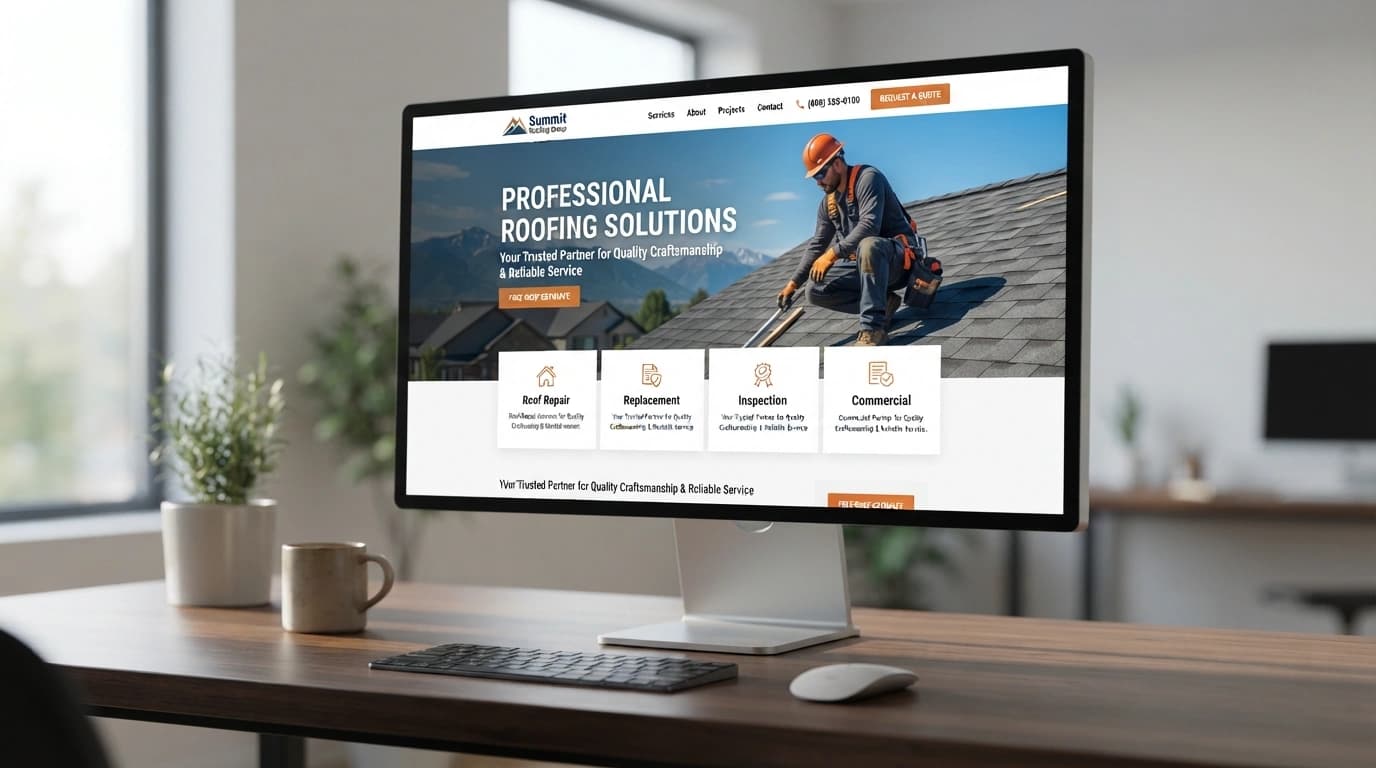
Roofing web design is mostly a CTA problem and a trust-signal placement problem
Roofing website problems are often deeper than visual style. Conversion paths, trust-signal placement, mobile usability, service-area relevance, and measurement can matter as much as aesthetics, so we diagnose those systems before assuming a redesign alone will improve performance.
The primary CTA should match the contractor's actual sales process. If the company sells through an inspection, the site should make scheduling that inspection straightforward. If the company can quote remotely or needs qualification first, the CTA should reflect that instead. We use analytics and sales-process data to choose the path rather than claiming one phrase universally wins.
The second lever is trust signal placement. Storm-chaser concern is a structural feature of roofing buyer psychology — homeowners are actively pattern-matching against out-of-state contractors, asking questions like "is this a real local company?" and "how long have they been in business?" before they'll engage. Most roofing sites have the answers somewhere — usually on the About page. The conversion-aware version surfaces those signals everywhere: years in business in the header, license number visible on every page footer, manufacturer certifications on service pages, real local address with a Google Street View match in the footer, BBB and insurance carrier names where they'll be seen. Trust signals on the About page support the buyer who's already committed. Trust signals on every page convert the buyer who hasn't.
The third lever is the insurance-claim path. When claim-driven work is a real part of the business, these buyers may need different information about inspections, documentation, adjuster meetings, and what the contractor can and cannot do. A dedicated page can answer those questions without making claim-outcome promises.
The fourth lever is mobile-first conversion architecture. A meaningful share of roofing inquiries come from a homeowner standing in their backyard, looking at visible storm damage, on their phone, often during or right after a weather event. The conversion patterns that work on desktop — multi-step forms, detailed information capture, CTAs at the page bottom — don't work for that moment. They need tap-to-call, photo upload, sticky call buttons that follow the scroll, and minimal friction between "I see damage" and "a roofer is on the phone." Sites designed desktop-first and adapted to mobile lose this buyer; sites designed mobile-first and adapted to desktop don't.
Some roofing site rebuilds get fixated on the visual refresh — the new logo placement, the bigger hero image, the cleaner navigation — and underinvest in the four levers above. The result is a prettier site that converts at the same rate as the old one. Done right, a roofing site rebuild starts with conversion architecture, then layers visual design over a foundation that's already engineered to perform.
"A roofing website's job isn't to qualify the buyer's budget. It's to get the inspector on the roof. The website that books the inspection wins — even if the website that asks for a quote looks better."
Why most roofing websites underconvert
"Get a Quote" as the primary CTA
A quote request and an inspection request create different expectations. For companies that sell through an on-site inspection, the CTA should reflect that process and make the next step clear rather than forcing every buyer into a generic quote form.
Trust signals buried on the About page
Years in business, local address, license number, manufacturer certifications — most roofing sites have these somewhere, but only on the About page. Buyers in conversion mode are on service pages, landing pages, contact pages, gallery pages — and the trust signals aren't there. In a category where storm-chaser fear actively shapes buying decisions, surfacing legitimacy signals on every page is conversion architecture, not branding work.
Stock photography instead of real project work
Generic shingle photos, anonymous "happy homeowner" stock images, drone shots that aren't even of houses in the local market — buyers spot this immediately and the trust deficit is permanent. Real project photos from the local service area, with captions naming neighborhoods, signal what stock can't: that you actually do work in this market, on real homes, in volumes you can document. Most roofing sites haven't made the switch and don't realize how much it costs them.
No dedicated storm-response landing page
Storm-damage buyers can have specific concerns around inspection availability, local proof, insurance questions, and next steps. A dedicated storm-response page can make those answers easier to find when weather-related demand changes.
Visual polish is only one part of website performance
A site can look modern and still create friction if the primary CTA, trust signals, mobile path, insurance information, or measurement setup are weak. We prioritize the parts of the experience that can be observed and improved rather than assuming a visual refresh will change lead volume by itself.
The six conversion architecture pillars
Each pillar addresses a different source of friction. CTA language and trust-signal placement are often practical early tests because they can be changed without a full redesign, but their impact should be measured on the site rather than assumed in advance.
Free inspection as primary CTA, not "Get a Quote"
For many roofers, an inspection-oriented CTA can create less friction than asking for a quote before the roof has been evaluated. We test the primary CTA against buyer intent and the contractor's sales process instead of claiming one phrase will always convert better.
Trust signals ambient on every page
Storm-chaser fear is a structural feature of roofing buyer psychology — homeowners are actively pattern-matching against out-of-state contractors. Years in business, local address with Google Street View match, license number, manufacturer certifications (GAF Master Elite, Owens Corning Platinum, CertainTeed SELECT), insurance with named carrier, BBB accreditation. Most roofing sites bury these on an About page. The conversion-aware version surfaces them on every page header or footer, on every landing page, on every CTA section.
Insurance claim funnel as a separate conversion path
Homeowners mid-insurance-claim need a different page flow than homeowners shopping for a planned replacement. Different objections ("will my insurance cover this?"), different resources needed (claim documentation help, adjuster meeting prep, supplement requests), different CTAs ("Schedule Storm Damage Inspection" vs. "Get Replacement Quote"). Most roofing sites have one funnel and force insurance buyers through the wrong door, where they bounce. A dedicated insurance claim flow with its own landing page, content, and CTA is one of the highest-leverage adds.
Material-specific galleries with location captions
Real project photography can help roofing buyers evaluate workmanship, materials, and local experience more credibly than generic stock imagery. We organize galleries by project type or material where enough real work exists and add accurate location context only when the contractor has permission to publish it.
Financing transparency surfaced upfront
Roof replacement is a high-consideration purchase, so financing information can reduce uncertainty for buyers who need to understand payment options before scheduling an inspection or consultation. We surface financing where it is genuinely available and explain terms clearly without implying approval or savings outcomes.
Mobile-first conversion patterns
A meaningful share of roofing inquiries come from a homeowner standing in their backyard, looking at visible storm damage, on their phone. Multi-step forms don't convert these buyers. "Tap to call" buttons convert. "Submit a photo of the damage" CTAs convert. Sticky mobile call buttons that follow the user as they scroll convert. The mobile experience for roofing isn't a smaller version of the desktop experience — it's a different conversion architecture optimized for the storm-damage-from-the-backyard moment.
Storm-response pages need to exist before the storm
When a major weather event hits and roofers scramble to point paid traffic somewhere, most send it to the homepage or a generic services page. Storm-damage buyers have specific concerns — insurance claim handling, immediate inspection availability, evidence of local work, emergency response — that homepages don't address, and conversion rates collapse. A pre-built storm-response landing page activated during weather events typically converts at multiples of homepage conversion. It costs nothing to maintain dormant. It costs leads to not have when weather hits.
The eight page types every substantive roofing site needs
Roofing buyers split across multiple intents and arrive at the site through different doors. A site with only a homepage and a services page leaves most of those entry points unhandled. The architecture below covers the actual buyer journey instead of squeezing every visitor through a single funnel.
How we work on roofing web design engagements
Conversion audit + strategy
We review your current site, analytics, competitor sites, and buyer mix across planned replacement, insurance-related work, repair, and commercial intent. We identify where the current experience is creating measurable friction before any design work begins.
Information architecture + page mapping
We map the page architecture (homepage, service pages, material pages, insurance claim landing, service-area pages, gallery, storm-response page, About) against your buyer mix and SEO targets. Every page gets a defined role, primary CTA, and content brief before any design happens. This is where most rebuilds quietly fail — by skipping straight to design without architecture work.
Mobile-first design + trust hierarchy
Design starts on mobile because that's where the storm-damage-from-the-backyard buyer lives. Trust signals get placed ambient across the design system — header, footer, CTA sections — not concentrated on a single trust page. Visual design layers on top of architecture that's already engineered to convert.
Content production + real photography
Real project photos with location captions (your photographer or ours), material-segmented galleries, service-page content depth, insurance content, financing transparency, real team photos, real testimonials. Stock photography is replaced with documented local work. Content production runs parallel to build, not after.
Build, launch, and ongoing CRO
Build phase, QA, launch — then ongoing conversion rate optimization. Heat maps, form analytics, A/B testing on CTAs and headlines, monthly conversion review tied to lead volume and quality. A roofing site isn't finished at launch — it's a living asset that should improve every quarter for as long as it's your primary marketing surface.
Roofing web design FAQs
How much does a roofing website cost?
How long does a roofing website build take?
Should I use WordPress, Webflow, or a custom build for my roofing site?
What's the most important page on a roofing website?
Do I really need a separate insurance claim landing page?
How important is mobile design for roofing sites?
Can't I just use one of those roofing-specific website builders?
Web design is the conversion surface. Here's what feeds it.
Want to know what your
site is actually leaking?
Get a free roofing web design audit. We'll review your CTAs, trust signal placement, mobile experience, page architecture, insurance funnel, and conversion rate against benchmarks — and tell you what's working, what's broken, and what to fix first. No pitch.