Solar Lead Generation
Most solar lead generation pitches focus on lead volume. We focus on lead quality, attribution, routing, qualification, and follow-up so you can understand which inquiries are actually turning into sales opportunities.
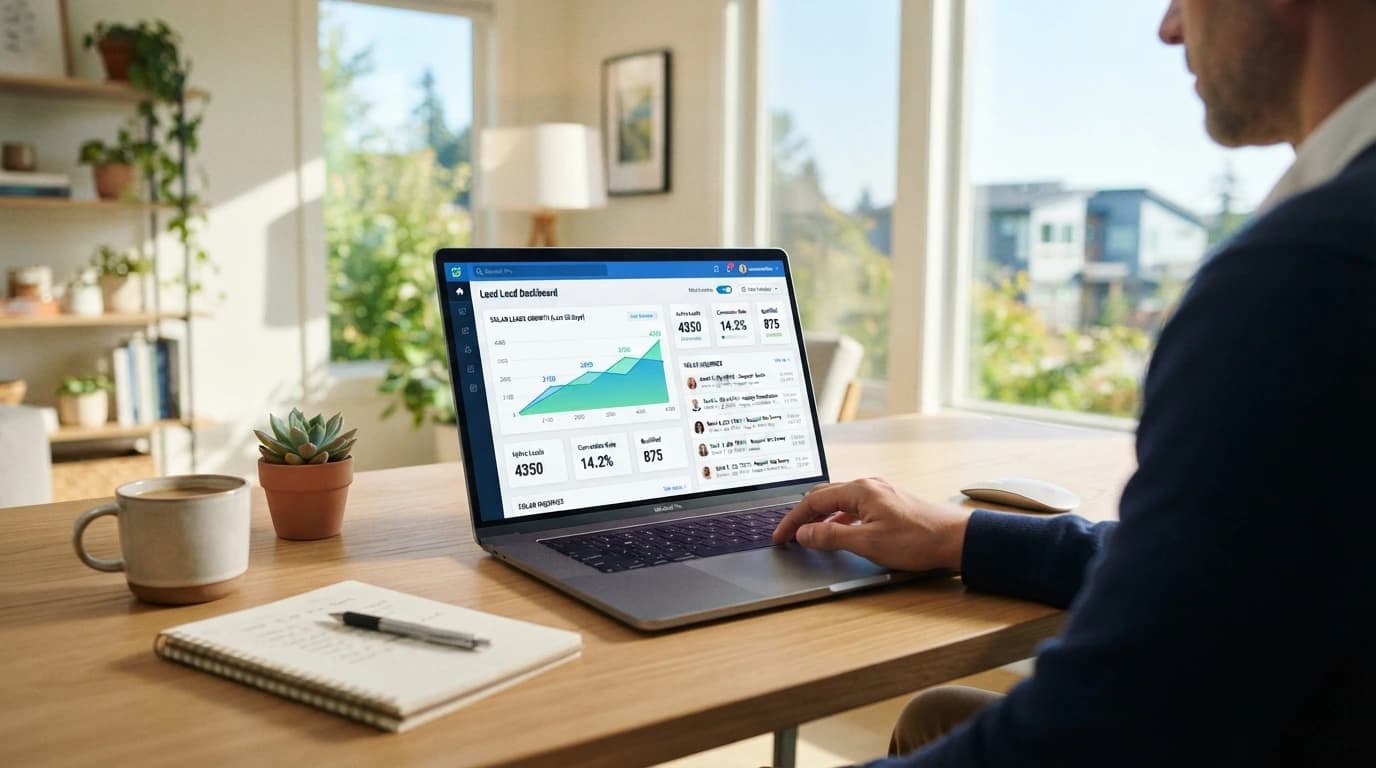
Solar lead generation is mostly a quality problem disguised as a quantity problem
Lead volume is only one part of a solar acquisition system. More inquiries do not automatically create more revenue if qualification, attribution, routing, follow-up, and sales-stage measurement are weak. We start by understanding which sources are already producing qualified opportunities and where leads are dropping out of the process.
The constraint may be lead quality, attribution, response process, qualification, sales capacity, or demand itself. That is why we evaluate the whole funnel instead of assuming that increasing the top-line lead count is the right first move.
Solar lead generation works best as a system rather than a disconnected set of campaigns: multi-channel capture, clear qualification criteria, prompt routing and follow-up, permission-based nurture, CRM integration, offline conversion tracking where available, and regular review of which sources are producing qualified opportunities.
Brokered leads and owned acquisition channels each involve tradeoffs. Buying leads can add an external source of inquiries, while owned channels give you more control over targeting, content, measurement, and the customer journey. We compare the economics and strategic tradeoffs rather than assuming one model is always correct.
"Most solar lead generation problems aren't solved by adding more leads. They're solved by qualifying harder, responding faster, nurturing longer, and cutting channels that look good in vanity reports but never produce installs."
Why most solar lead generation programs underperform
Buying recycled leads from brokers
Some lead vendors sell shared or non-exclusive inquiries to multiple installers. That can create more competition for the same buyer and makes the economics highly dependent on source quality, response process, exclusivity terms, and close rate. We recommend confirming in writing whether a lead is exclusive, how it was generated, and what happens when an inquiry is invalid or outside your criteria.
Optimizing for lead volume instead of lead quality
Lead volume alone is not enough to judge performance. A smaller source of well-qualified opportunities can be more valuable than a larger source of inquiries that rarely progress. We compare channels using qualification, booking, show, close, and revenue data where those stages are tracked reliably.
Slow first-touch response time
Slow follow-up can reduce the chance of reaching a buyer while the inquiry is still active. We design routing, notifications, scheduling, and ownership rules so qualified inquiries are handled promptly, then measure what response patterns actually correlate with booked consultations in your own data.
Treating short-cycle leads as the only kind
A buyer who does not book immediately may still be researching or comparing options. Instead of treating every non-response as a dead lead, we use lifecycle stages and permission-based nurture to keep useful information flowing until the buyer opts out, becomes unqualified, or is ready for another conversation.
The honest truth about solar lead brokers
Lead-vendor quality varies. Before buying, confirm whether the inquiry is exclusive or shared, how and where the lead was generated, what consent language was used, which qualification criteria apply, and what replacement or refund policy covers invalid leads. Those terms should be documented rather than assumed.
The six pillars of an actual solar lead generation system
Each one fails on its own. Together they form a working engine. Most solar companies have one or two of these in place and assume that's the whole system.
Multi-channel lead capture
Leads from SEO, PPC, LSAs, social retargeting, and referrals all flowing into one consolidated intake. Most solar companies have three or four channels running independently with no unified view of where their leads actually come from. We build the routing so every inquiry gets attributed and every channel's ROI is measurable.
Lead qualification framework
Not every inquiry is a fit. We build a qualification layer — usually a mix of self-qualifying form fields, savings-estimator inputs, and an AI or human first-touch — so your sales team can prioritize inquiries that match the service area, project type, and buying criteria you define.
Appointment setting + booking
Direct booking via Calendly or Cal.com for buyers who self-qualify. Human appointment setters or AI voice agents for buyers who need a phone touch first. Most solar leads die in the gap between form fill and first contact — speed of response and friction of booking are usually the biggest leakage points.
Long-cycle nurture
Solar can involve a longer consideration process than a simple transactional purchase. We build email and SMS nurture around financing questions, incentive updates, installation proof, customer stories, and other useful information so leads can keep engaging until they are ready to take the next step.
CRM + offline conversion tracking
Leads tied back to their originating channel through CRM integration and offline conversion imports. So when a buyer who first hit a blog post in March books a consult in September, the attribution holds. Without this, every other piece of the system reports lies — and you can't make budget decisions on lies.
Lead quality monitoring
We review disposition data such as qualified inquiries, booked consultations, completed appointments, closed contracts, and attributed revenue where tracking supports it. Channels are evaluated on downstream quality rather than lead volume alone, and budget decisions follow the evidence available in the CRM and ad platforms.
How solar lead sources actually compare
Not all lead sources behave the same way. We compare each source using qualification, booking, close, revenue, exclusivity, and strategic-control data rather than relying on a universal ranking.
Compare lead sources on total acquisition economics
Owned channels and brokered leads have different cost structures and levels of control. We compare media or vendor cost, management cost, qualification rate, booking rate, close rate, contract value, exclusivity, and measurement quality before deciding where additional budget should go. The right answer comes from your economics, not a universal rule.
How we work on solar lead generation engagements
Lead audit + unit economics review
We review your existing lead sources, qualification process, response handling, close data by channel where available, and current acquisition economics. The goal is to establish a trustworthy baseline before adding budget or lead volume.
Qualification + response infrastructure
Before adding lead volume, we define qualification criteria, intake fields, routing rules, notification ownership, scheduling options, and CRM stages. The goal is to reduce avoidable handoff friction and create data that can be measured consistently.
Multi-channel capture build-out
We sequence channel investment from your starting point, demand, budget, and measurement readiness. Paid search, eligible local ad products, SEO, content, social, referrals, and retargeting can each play a role, but the mix is adjusted according to qualified-opportunity data rather than a fixed formula.
Long-cycle nurture system
Email and SMS sequences can support buyers who are still researching: financing updates, incentive information, installation proof, customer stories, and comparison content. Messaging is tied to CRM stages and consent so follow-up reflects where the buyer is in the process.
Quality monitoring + channel rebalancing
We review channel-level disposition data such as inquiries, qualified leads, completed appointments, closed contracts, and contract value where those stages are available. Budget decisions are based on downstream quality and revenue evidence rather than lead count alone.
Solar lead generation FAQs
Should I buy solar leads or build my own lead generation?
What's the difference between exclusive and shared solar leads?
What's a realistic cost-per-acquisition target for solar?
How fast can a lead generation system start producing?
How do you measure lead quality vs. just volume?
What about AI lead qualification and AI voice agents?
Will you guarantee a specific number of leads per month?
Lead generation is the system. Here's the channel work that feeds it.
Want to know your
real cost-per-acquisition?
Get a free solar lead generation audit. We'll review your channel mix, lead quality, response time, qualification process, and unit economics — and tell you which channels are profitable, which ones are bleeding, and what to fix first. No pitch.