Solar PPC & Google Ads
Solar paid-search economics can be challenging in some markets. We build PPC programs that separate research intent from consultation intent, improve landing-page qualification, and report on booked consultations and acquisition economics rather than cost per click alone.
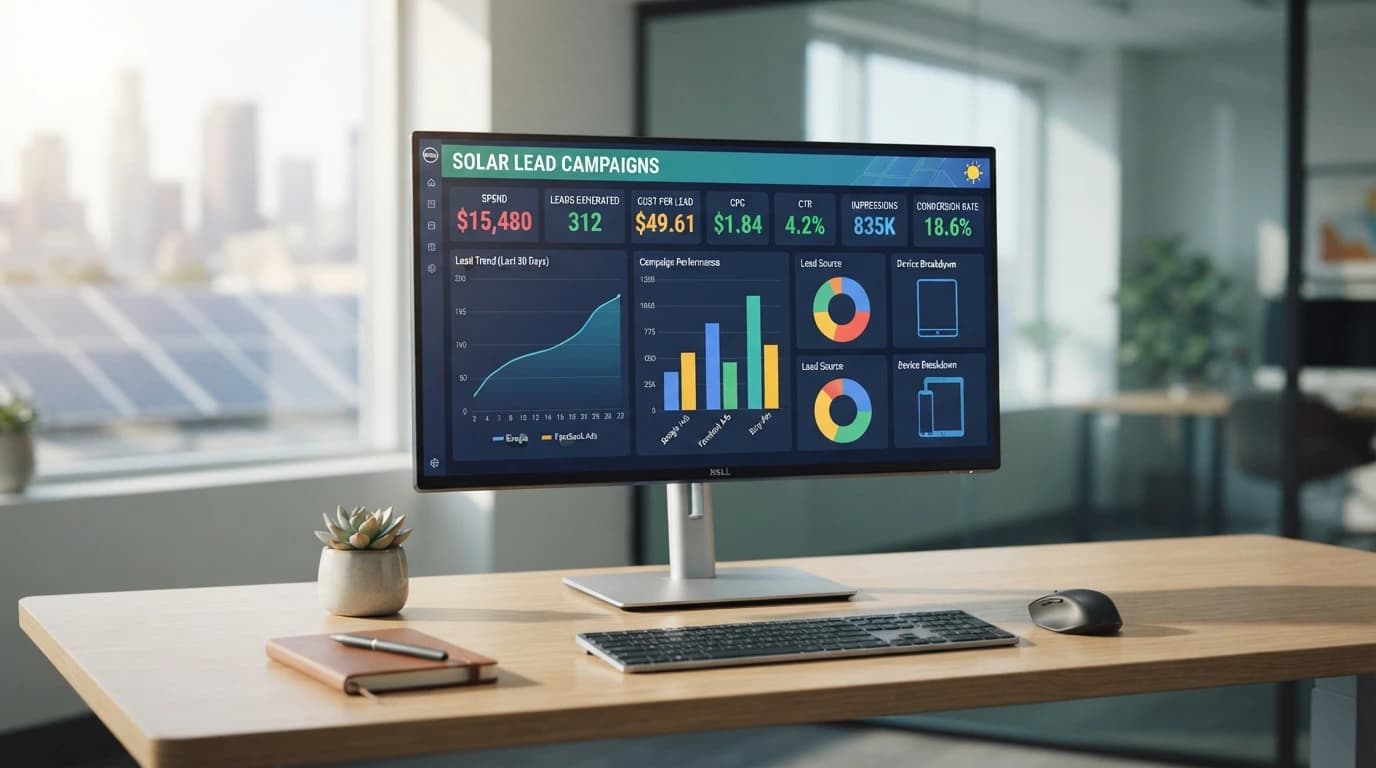
Solar PPC is a discipline problem, not a budget problem
Most solar companies running paid ads have the same diagnosis: spending too much, getting too few qualified leads, and watching CPCs climb every quarter. The instinct is to spend more, hire a bigger agency, or layer on more channels. The actual fix is almost always the opposite — spend less on paid until the funnel catching those clicks stops leaking money.
Solar paid-search economics vary widely by market, but the conversion path always matters. As a simple illustration, improving a landing page from a 1% conversion rate to 4% would reduce cost per inquiry by 75% at the same click cost, before booking rate, show rate, and close rate are considered. That is why we evaluate the experience after the click before scaling media spend.
The other half of the discipline problem is keyword strategy. Research queries — "is solar worth it," "how much do solar panels cost," and "solar tax credit explained" — can be useful content topics without necessarily belonging in a consultation-focused paid campaign. We separate informational demand from bottom-of-funnel intent such as "solar installer near me," "solar quote [city]," and "solar consultation."
Get the funnel and the keyword strategy right and PPC works as it should — immediate demand capture while SEO compounds in the background. Get them wrong and you're effectively paying Google to test how broken your site is.
"Most solar companies don't need to spend more on paid. They need to stop sending expensive traffic to a leaky funnel — and stop bidding on queries that belong to SEO."
Why most solar PPC programs lose money
Spending paid budget on a leaky funnel
One common source of waste in solar PPC is sending expensive traffic to a generic page with a weak conversion path. The relationship is simple: higher click costs and lower conversion rates raise acquisition cost quickly. We fix tracking, message match, qualification, and landing-page friction before scaling spend.
Paying for research queries that may not convert quickly
Research queries such as "is solar worth it" and "how much do solar panels cost" can consume paid budget without producing near-term consultations. We separate informational demand from bottom-of-funnel intent and reserve paid spend for the queries that match the campaign goal.
Letting Google's automation run unchecked
Google Ads increasingly offers automated bidding, broad-match, and Performance Max options, but those tools are not automatically right for every solar account. We use automation selectively, maintain exclusions and negatives where available, review placements and search-term quality, and judge the setup from downstream lead economics rather than platform defaults.
Optimizing for clicks instead of consultations
Cheap clicks are not useful if they do not become qualified opportunities. A falling CPC is not automatically a win if targeting broadens and lead quality falls. We prioritize downstream measures such as booked consultations and qualified opportunities over cost per click alone.
The five paid channels solar PPC actually covers
Most solar companies should run two or three of these — not all five. We start with the channels that match your buyer stage and budget, then expand only when the data justifies it.
Google Search Ads
The biggest spend bucket and often the most competitive. We tightly target high-intent keywords, build negative-keyword coverage around irrelevant research, DIY, employment, and product-only queries, and structure campaigns by buyer stage — not by service.
Local Services Ads (LSAs)
Pay-per-lead, not pay-per-click. Google verifies your license and insurance, displays you above search results, and only charges for actual phone calls or messages. For most local solar installers, LSAs deliver lower CPL than search ads — but they require active review management and dispute work most agencies skip.
Performance Max (with guardrails)
Performance Max is a black box that Google would love you to just trust. We don't. We run it for solar with strict negative keyword lists, asset group separation, audience signals tied to in-market solar buyers, and weekly placement audits to keep it from spending budget on display garbage.
Meta retargeting (not prospecting)
We generally treat Meta as a retargeting and nurture channel before using it for broad cold prospecting. It can bring non-converting site visitors back during a longer solar research cycle, using a different objective, creative strategy, and budget logic than search.
YouTube + display (proof-heavy only)
For YouTube, we favor proof-led creative such as installation footage, customer interviews, and clear offers over generic brand spots. Display is used selectively, primarily for retargeting visitors with creative matched to their stage of consideration.
What drives solar PPC economics
There is no single defensible CPC, CPL, CAC, or monthly-budget benchmark for every solar advertiser. These are the variables we use to evaluate whether a paid program is economically sound.
When we tell clients to spend less
If the landing page is underperforming, call tracking is unreliable, or the CRM cannot tie booked consultations back to source, adding media spend can amplify the measurement and conversion problems. We would rather fix those foundations first and scale only when the data supports it.
How we work on solar PPC engagements
Account audit + funnel diagnostic
We review your existing campaigns, negative keyword lists, landing page conversion rates, call tracking setup, and CRM attribution. The goal is to identify structural problems that should be fixed before scaling spend.
Funnel + tracking foundation
Before scaling spend: dynamic call tracking, offline conversion imports for booked consultations, landing page review and improvement where the data shows underperformance, and CRM integration. These foundations determine whether campaign results can be measured and improved reliably.
Channel mix + campaign rebuild
We rebuild Google Search around bottom-of-funnel intent, evaluate LSAs where eligible, use Performance Max only with appropriate controls, and add Meta retargeting when it fits the buyer journey. We recommend a channel mix based on demand, budget, and measurement readiness rather than launching everything at once.
Negative keyword + placement discipline
Solar requires aggressive ongoing negative keyword work — DIY queries, panels-for-sale searches, employment, news, research, competitor branded terms. We run weekly negative keyword reviews and weekly placement audits on Performance Max and display.
Reporting tied to booked consultations
Every report ties paid spend back to booked consultations and revenue — not clicks, not impressions, not even leads. If a campaign produces leads but those leads never book consults, we kill it. Cost per booked consultation is the only metric that matters.
Solar PPC FAQs
How much should I spend on solar PPC monthly?
Are LSAs worth it for solar companies?
Should I use Performance Max for solar?
Why are solar Google Ads so expensive?
Should I run PPC and SEO at the same time?
How fast can paid ads start producing leads?
What about call tracking and attribution?
PPC is one channel. Here's the rest of the solar program.
Want to see where your
paid budget is leaking?
Get a free solar PPC audit. We'll review your campaign structure, negative keyword lists, landing page conversion, call tracking, and channel mix — and tell you what's working, what's draining budget, and what to fix first. No pitch.